Showing posts with label China. Show all posts

31 July 2016

Great Wall of China at Huanghua Cheng

The Great Wall of China... one of China's, and indeed the world's most iconic testament to human ingenuity. This is no doubt visible to the visitor who witnesses the Wall snaking its way along rugged hillsides on and on.

It is of course a popular tourist sight and if you type in 'Great Wall crowds' into Google Images, you'll get a profound sense of the Wall's capability to handle the humongous masses. These images are a clear proof of China's burgeoning domestic tourist industry.

Believe me, you don't want an experience like that. One of the pleasures of the Wall is to look back at it snaking its way around empty countryside. Not to have a thousand people blocking the view you so dearly crave for.

There are a number of different sections of the Wall around Beijing and the most popular tend to be the sections at Badalling and Mutianyu. Fortunately there is another section not too far from Beijing,easily accessible as a day-trip, which sees far fewer crowds.

Welcome to Huanghua Cheng.

Why Huanghua Cheng?
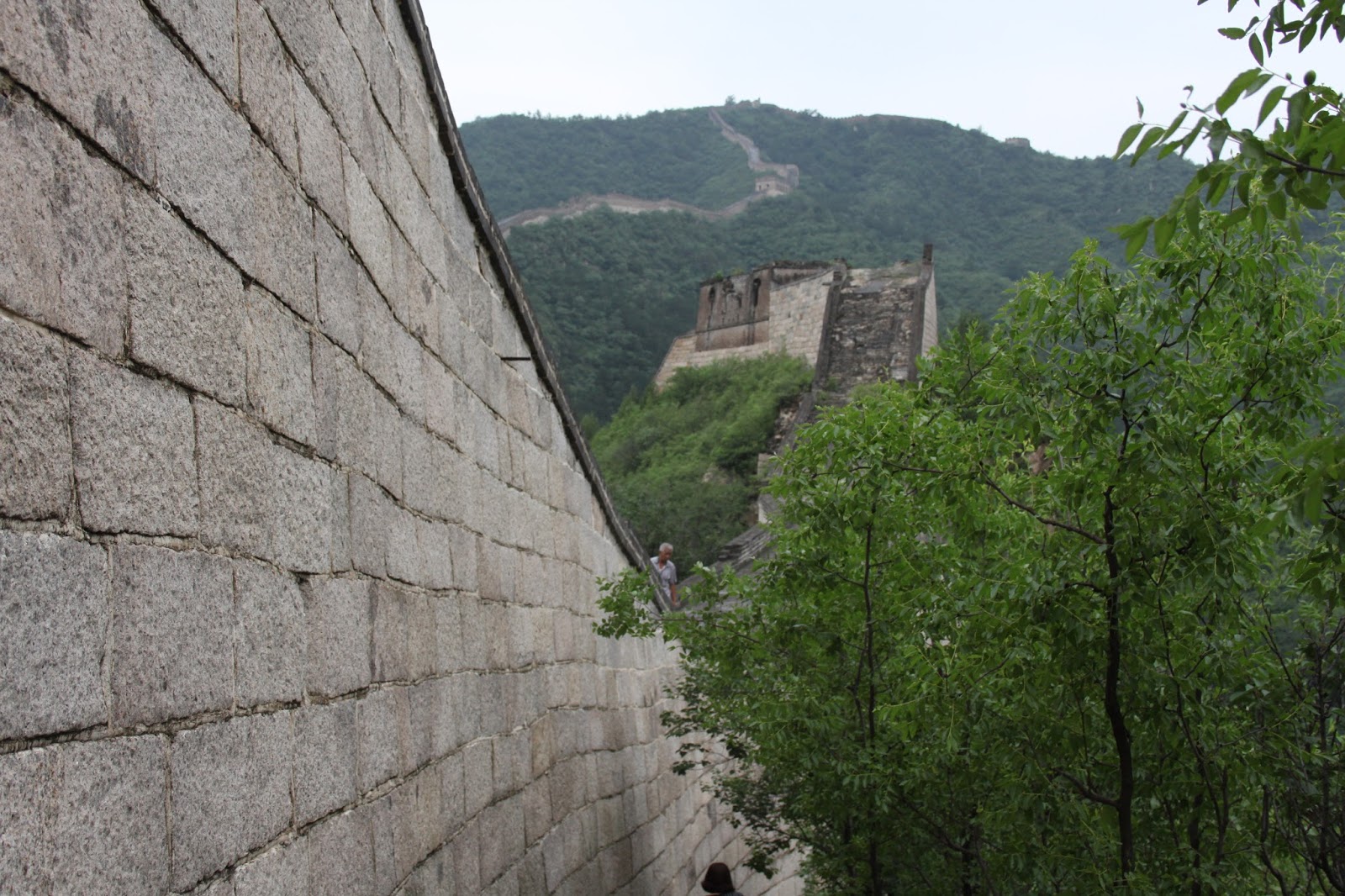
The only section of the Wall by a reservoir, Huanghua Cheng provides a scenic and steep Wall first built about 1000 years ago by the Ming dynasty. There has been some restoration work done but there is enough of the rough, wild wall left.

This Wall does see fewer crowds, making it a pleasure to enjoy in serenity. I arrived on a Saturday morning around 9:30 am and had the Wall almost to myself for over a good half an hour before a few more arrived. I imagine it being even quieter during the weekdays.

How to get here?
You can hire a taxi but if you are like me- without the money for one (and in the mood for an adventure), take the bus, which requires some advance preparation. If you do choose a taxi, expect a round-trip to cost around 500-700 yuan (bargain!). Do not get a taxi one-way as you will not find one here for the way back. Ask yours to wait while you enjoy the Wall.

While taking the bus, it is best to get the IC Card (see here for more information), the card you can use for intra-city buses and subway. It is straightforward to load using a machine in any subway station. I am not sure how much the entire bus trip cost me, but it was in the range of 25 to 40 yuan. I recommend you to load more before leaving, just in case you get lost and end up somewhere else.

You have to take 2 buses to get to the Wall. First, take bus 916 express. (916). This begins from the hub at Dongzhimen, in Beijing's Chaoyang district. If you take the subway to Dongzhimen (lines 2, 13 and the Airport Express), follow signs to the bus terminal and then the North bus bays.

This bus will have a screen showing the next station in Chinese, with announcements in Chinese too. You need to get down at Nanhuayuan Sanqu (南华园三区). Try to remember some of the characters of the name so you can tally it with the screen. This journey will take about 60-90 minutes, so you can just sit, relax and enjoy the views. A few minutes before reaching the stop, I (being the only tourist on the bus) was approached by a couple of touts who asked if I wanted to get on a minibus (presumably to Mutianyu), so beware of this (i.e. you do not need to get down until you reach the stop).

The street scene at Nanhuayuan Sanqu bus stop

Once you get down at Nanhuayuan Sanqu, walk straight for a few minutes, until you reach the next bus stop, called Nanhuayuan Siqu (南华园四区). The sign placards will only list a few bus routes, but there are many more which serve this stop, whose numbers are prefixed with 'H'. The bus you need is H14.

Before getting on this bus, make sure that you verify with the driver that the bus is taking you to Huanghua Cheng (黄花城) by having it written (or in a guidebook). The few people hanging around the bus stop hounded me to take their private car and were amused at me as I tried to find out the right bus. They will discourage you from taking the bus so stand your ground!

The bus H14 will not have a signboard so you need to ask the driver and the conductor where to get down. Bus stops along the route will look like those below- no name. This journey will take about another hour and the scenery becomes wilder and more beautiful as the ride progresses.

Along a particular curve of the road was a stop and a sign providing directions to something which read as "Lakeside Great Wall" or similar. The road cured to the right, while the sign led off to the left. I was informed that this was not my stop- I was told to get off at another stop a minute or two later, by the reservoir.


At the Wall
As you begin to walk towards the reservoir, you will be greeted by this sign. Yes, "officially" this section of the Wall is not open to the public but nobody seems to care really. A good number of tourists do come. A small stall providing basic food and snack items was set up, and is a good place to pick up some items though I would recommend you carry some food items from beforehand.

As you walk on the path over the reservoir, a local person may set up a small tent or such with a sign demanding a certain amount of money to proceed on the Wall. This is all unofficial of course, but I decided to pay to avoid any issues. I had to pay 5 yuan. The path would lead on and it would take you about 10 minutes to get to the Wall, while the majestic structure looms above you. On the path were also some shacks set up with what seemed like another small shop, and it seemed like people actually lived here.

The reservoir and the surrounding scenery

The Wall... breathtaking


Once you get to the Wall, you have to climb a ladder to actually get on it. Then, you can either go in the straight-ish direction or in the opposite direction. The straight-ish direction leads on to a steep walk without any steps or rails so be careful! The views are simply incredible and you can spend ages just admiring the landscapes.

However, soon you reach the impossibly steep section, which I decided not to try to climb after a hesitant attempt. I am not even sure if people do climb it or not, but I decided not to try. I then headed off in the opposite direction, past my starting point.

Looking back towards my starting point
Heading off in the opposite direction, I discovered that I was not going to be alone any longer. A few travellers, all presumably local, began their hike on the Wall. Solo travellers, groups of friends and families with young children- the demographics were pretty diverse. By their looks, I understood I stood out being a foreigner, signalling that few foreigners came to this part of the Wall. Interestingly, everyone did head off only in the opposite direction and not in the direction I initially went in.

Parts of this part of the wall seem to be restored.


Walk on, and you arrive at another watchtower, which has a rickety ladder to climb. A couple of rungs in, I was not confident in the sturdiness of the ladder.

Brave enough to try? (I wasn't.)
In this direction, the wall goes on and on, and can be walked for a while. I am not sure if it connects to another section of the Wall.

I decided to return back to my starting point. The only public toilets were on the main road (where the bus drops you).

The toilets- needless to say, you would like to keep
your contact with them at the bare minimum
How to get back?
There is no familiar-looking bus stop on the road to get a bus in the opposite direction. Instead, you will find this sign:


Wait here and flag down an H14 bus to take you back. Tell the conductor you want to get to Nanhuayuan Siqu (南华园四区). I was not dropped at the bus stop opposite to where I was picked up, so when you get dropped, find the nearest bus stop with the placard showing a 916 express bus back to Dongzhimen.

Once you get the 916 express, sit back and reflect on this action-packed day at the Wall.

If you have any feedback, questions, or if you have done this trip too, feel free to comment! 

27 July 2014

Dalian

Dalian is a coastal city in the province of Liaoning in north-east China with a population of around 3 million. It is a popular tourist destination for domestic Chinese tourists and is known as the "square city" in China, with several beautiful squares.

HIGHLIGHTS
1. Witnessing the fast-flowing traffic amid lit colonial architecture at the lively Zhongshan Sq in the evening.
2. Admiring the green and hilly surroundings in the large, calm Heng Shan Temple.
3. Roam around aimlessly the tiny inner lanes of the central district.
4. Travelling on Binhai Rd and stopping at the various viewpoints
4. Walking up to the TV Tower.

CITY MAPPING
For the tourist, most places of interest lie in three districts, namely Zhongshan district, Xigang district and Shahekou district. The airport is located north-west of the center.

SIGHTS
The Harbour area at the eastern end of Zhongshan district is a wide open area, nice to take a walk around in and feel the cool sea breeze. It is a popular area particularly in the evenings, but with absolutely nothing, it is a wide empty area and is popular with cycling as well. The entrance is on Ren Min Dong Lu, and is close to the Dalian International Convention Center.

Dalian Harbour area
Squares
From the harbour, walk west on Ren Min Dong Lu until you reach the first square, Gangwan Square which has a few pieces of colonial architecture.

Gangwan Sq
Continue walking straight on Renmin Rd and you will enter one of the city's downtowns, with many hotels, commercial buildings, restaurants and shopping centers. Keep on walking straight until you reach Zhongshan Sq, one of the city's main squares in the heart of the financial district.

Dalian was a colony of both the Japanese and the Russians and colonial architecture can be seen here, amongst other places. Most of the colonial buildings now serve as banks or other financial institutions. 

Zhongshan Sq
The center of the roundabout is a popular place for locals, especially in the evenings. Dances and other performances often take place here. Some of the buildings are lit at night and it's worth coming for great photos at night. 

Continue straight from Zhongshan Sq, and Renmin Rd becomes Zhongshan Rd. A little further is Friendship Sq (Youhao Sq), at whose center is a crystal ball. 

Friendship Sq
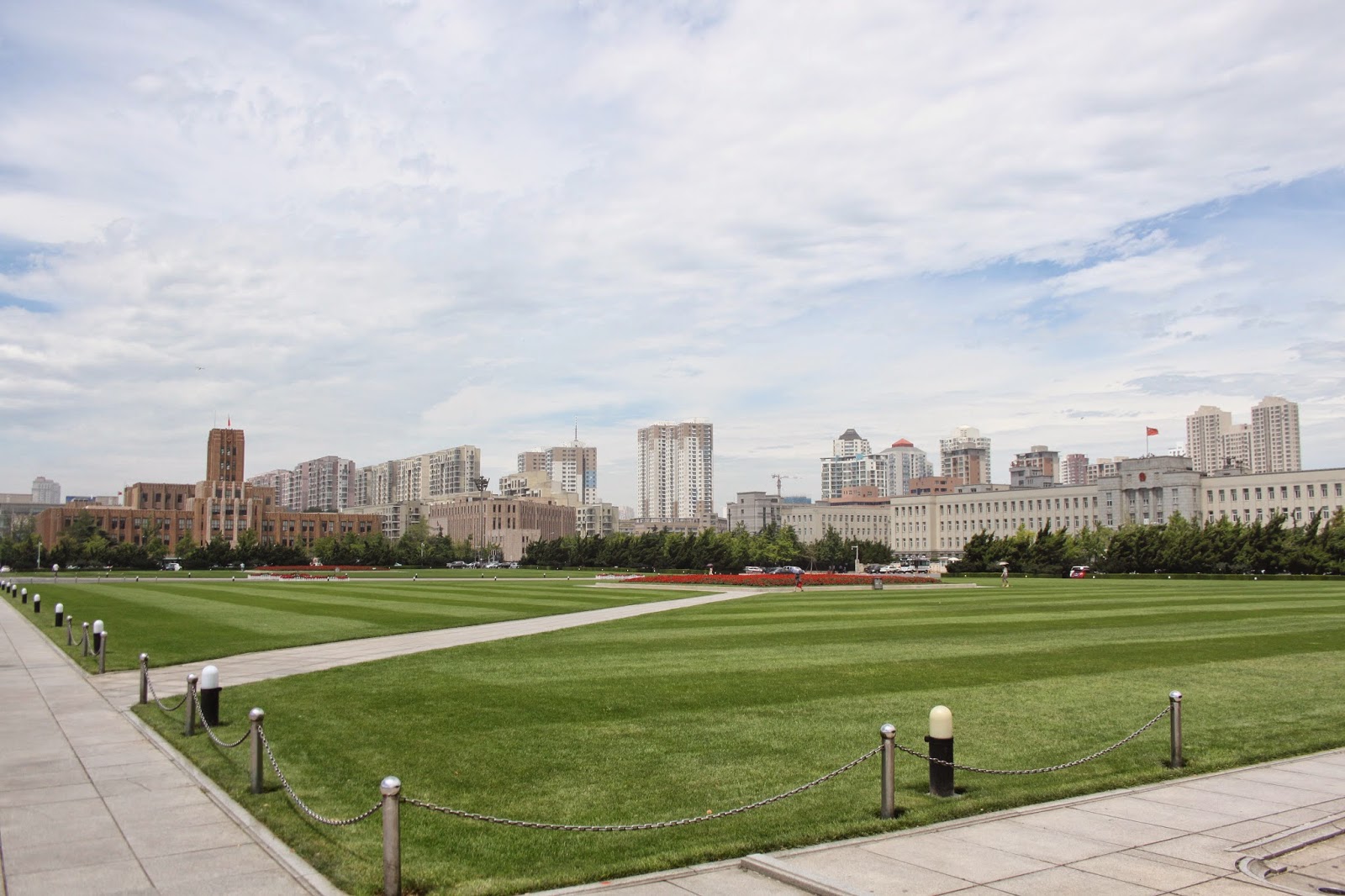
Further continuing on Zhongshan Rd, in Xigang district is People's Sq (Renmin Sq), flanked by major government buildings on all sides. The square is quite large, and there are nice shady places to sit in where the din of the traffic disappears.

People's Sq
Among the important buildings located at the square are the City Hall and a court.

Located in Dalian is Asia's largest square called Xinghai Sq. Around the area are major tourist attractions such as the Shell Museum and the aquarium. The Dalian International Beer Festival, which occurs every year in July-end, takes place here.

Around Xinghai Sq
The area is very popular with domestic tourists. If you can put up with the crowds, the cool sea breeze is rewarding!

Colonial architecture
See Zhongshan Sq and Gangwan Sq above.

Besides, some colonial architecture is located around Russian Street. With the development of Dalian, much colonial architecture has been destroyed and replaced by modern facsimiles of Russian architecture, however some truly old architecture does exist. Also around are many tourist shops selling Russian dolls among other items.

Part of Russian St
Parks
With respect to city parks, Dalian is well served by Labor Park (Laodong Park), a large well-maintained city park. It's a great place to meander along, and serves as an access point to visit the TV Tower for views.

Labor Park with the TV Tower in the background

The park has amusement park-like rides for children, particularly on the eastern edge of the park. Access to the TV Tower is also from the eastern edge- one of the ways to get there is a 1.5 km uphill walk, along a green tranquil path. On the way there will be a barrier and a ticket booth (Y50) and from there it's only a little bit more to the entrance of the tower. You then get in the tower and take a lift to the viewing platform. The weather is often smoggy which can hinder views. 

Labor Park and beyond as seen from the base of TV Tower
Temples
On the outskirts of town is Heng Shan Temple, among the largest temples in north-east China. Set in green and calm surroundings, the only sound you can hear is the traditional Buddhist music if you come on a good day. It is said to be popular with domestic visitors but I got lucky: there were only a few other visitors. 

Heng Shan Temple
Other Sights
Often called the French Riviera of Dalian, Binhai Road is Dalian's seaside road with the twists and turns, and the rocky surfaces which did remind me of the French Riviera or the Amalfi Coast. There are several viewpoints and tourist attractions, such as Tiger Beach, on the way. 

Binhai Rd
SHOPPING
Very close to Friendship Sq, around one or two traffic lights west on Zhongshan Rd, is the underground Victory Sq shopping center. You will see many entrances to it but strangely there are few exits when you are underground. The layout is confusing and signs are only in Chinese so enter only if you have enough time. There are lots of different types of shops, from hairdressers to restaurants.

Nearby is a large area with modern malls such as New Mart as well as outdoor shops and stalls. Has some global brands and food courts as well as Starbuck's, McDonalds and Haagen Dazs. 

Wen Cho shopping centre is a fine place to shop for souvenirs.

ACCOMMODATION
We stayed at the Conrad Dalian, a new property at the eastern edge of Zhongshan district, close to the International Convention Centre, Harbour and Gangwan Sq.

Rooms- 9/10 Spacious and beautifully designed very clean rooms. The bathroom has a powerful rainshower and an automatic toilet.
Staff- 9/10 Very helpful staff, particularly the concierge.
Location- 8/10 Close to Gangwan Sq and the Harbour. Next to the International Convention Center.
Breakfast- 7/10 Fine breakfast, no special comment here.
Overall- 35/40 Recommended. 

TRANSPORT
Taxis can be hailed off the streets, just stick out your arm. Flag fall is Y10 and a journey within the tourist areas shouldn't cost more than Y25. Drivers should use their meters- and they generally do. Even occupied taxis look for more passengers going in the same direction, don't be surprised if your taxi picks up somebody else or the taxi you hailed has another occupant. Taxi drivers do not speak English so have your accommodation write down addresses of places you'd like to visit, many will give a card with the hotel address and a list of important places.

Walking within the tourist district is a good way to explore some of the inner lanes and distances are not large. Pavements may be large but are always used for parking so you may end up walking on the road. Be careful while crossing, even a green pedestrian light may have vehicles turning right from the road or vehicles coming into that road. As for crossings not protected by lights, do NOT expect traffic to stop for you, cross with caution. Take particular care at squares such as Gangwan Sq, which have neither crossings nor lights, and traffic comes from multiple directions at once. No matter how beautiful the square is, watch out! For utmost care, walk around rather than through the square. As for other junctions, use underpasses whenever available. 

The main form of public transport is bus, although trams, both modern and historic, operate a few lines. 

SAFETY
Dalian is by large a safe city, with traffic being a concern you need to watch out for (see above). Take usual precautions you would in any large city, including being watchful of your bags and pockets.

TOURIST FRIENDLINESS 
Language is a major barrier with effectively no one speaking a word of English. Bring along a Mandarin phrasebook. However, people are generally helpful and waiters etc may wait patiently as you point out specific words in your phrasebook. Even a few words of Chinese will be appreciated.

Last visit- Jul 2014
No of visits- 1